Opuluxe BYRZYN: The Science of Topical PLLA and the Results of Our 9-Patient Case Study

In my 23 years of clinical practice, having performed over 40,000 treatments, I have witnessed a profound shift in the aesthetic landscape. We are moving away from the era of "over-filling" and moving toward a more sophisticated paradigm: Regenerative Aesthetics.
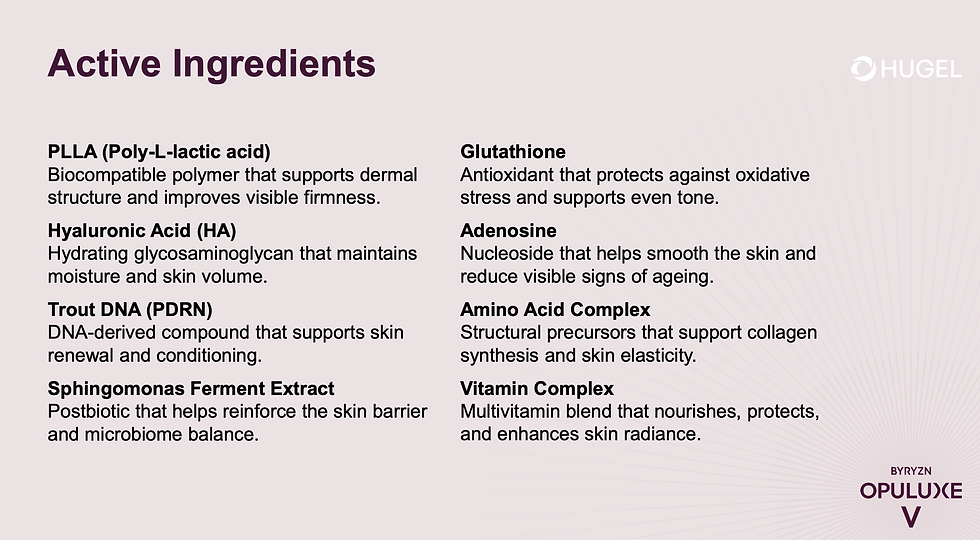
Patients are no longer simply asking to "look younger"; they are asking for better skin quality. They want skin that behaves younger at a cellular level. This is why I have focused my recent clinical research on Opuluxe BYRZYN (by Hugel Australia), a topical 8-in-1 formulation that combines Poly-L-Lactic Acid (PLLA) and PDRN (trout DNA).
To move beyond marketing claims, I conducted a 9-patient case study utilizing rigorous VISIA analysis and dermatology-grade photography. The results were not just visible: they were mathematically significant.
The Architectural Science: Why PLLA and PDRN?
When we discuss skin rejuvenation, I often use the metaphor of architectural restoration. Dermal fillers can provide volume (the "bricks"), but they do not necessarily improve the "mortar" or the health of the "scaffolding."
PLLA (Poly-L-Lactic Acid) has long been the gold standard in biostimulation. Traditionally used in Sculptra treatments, it works by triggering a sub-clinical inflammatory response that activates fibroblasts, the cells responsible for collagen production. However, BYRZYN Opuluxe introduces PLLA in a topical format designed for assisted delivery.
The formulation is further bolstered by PDRN (Polydeoxyribonucleotide), derived from trout DNA. PDRN acts as a biological "reset button" for the skin. It stimulates cellular regeneration and supports the TGF-β1 signalling pathway, which is critical for tissue repair and collagen synthesis. By combining these with postbiotics (Sphingomonas ferment extract) and glutathione, we are addressing skin vitality from multiple biological angles: hydration, antioxidant protection, and structural integrity.
The Protocol: Micro-needling Assisted Delivery
The primary challenge with high-molecular-weight ingredients like PLLA is penetration. The skin’s barrier is designed to keep foreign substances out. To bypass this, we utilize Micro-needling Assisted Delivery.
In our study, we followed a strict protocol:
Preparation: The skin is cleansed and prepped with hypochlorous acid to ensure a sterile field.
Micro-channeling: We utilized microneedling depths ranging from 0.5mm (periorbital and sensitive areas) to 1.5mm (cheeks and forehead).
The "Golden Window": It is critical to apply the BYRZYN serum immediately: before the micro-channels begin to close via the natural clotting cascade.
Zonal Treatment: To ensure maximum efficacy, I recommend treating the face in three distinct zones. Complete the needling and topical application for one zone before moving to the next. This ensures the serum is applied while the channels are at their most receptive.
Our 9-Patient Case Study: Methodology and Parameters
I am not interested in "filtered" before-and-afters. For this study, we employed Woodrow Wilson dermatology-grade photography and VISIA Complexion Analysis.
This technology allows us to see beneath the surface, measuring pore count, wrinkle depth, and UV damage with mathematical precision.
Sample Size: 9 patients.
Mean Age: 46 years.
Treatment Frequency: 3 sessions, spaced 3 weeks apart.
Imaging: Consistent SLR photography and VISIA scores recorded before the first session and 3 weeks after the final session.
Control: Patients were restricted from having any other injectable or energy-based treatments during the study period.

The Results: Quantifying the "Glow"
The data from the VISIA analysis was compelling. We focused on two primary metrics: Texture/Pore Count and Wrinkle Depth.

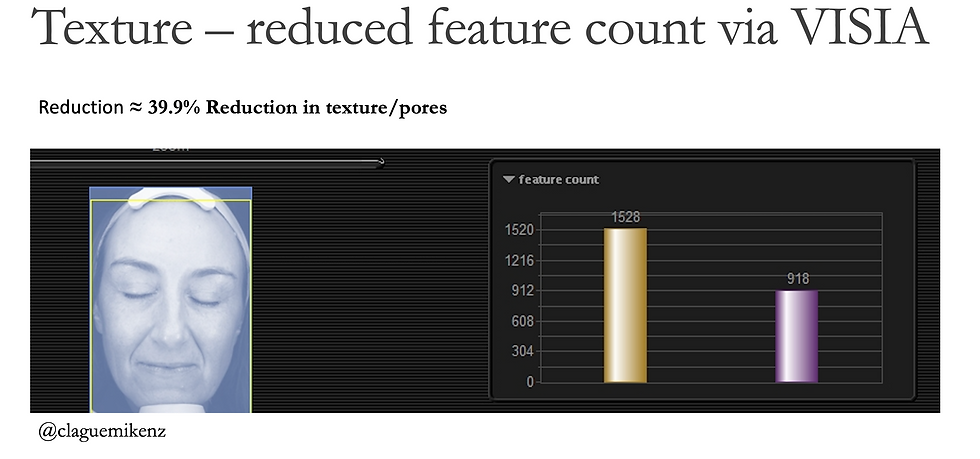
1. 39.9% Reduction in Texture and Pores
The most immediate and striking result was the refinement of the skin's surface. We saw a 39.9% reduction in the "feature count" of pores and rough texture. This is a direct result of the PDRN and PLLA working to tighten the ostia (pore openings) and improve the smoothness of the epidermis.
2. 35.4% Reduction in Wrinkles
Fine lines, particularly in the periorbital and perioral regions, showed a 35.4% improvement. Unlike fillers, which "push" the wrinkle out from beneath, this improvement represents a thickening of the dermis itself: the biological scaffolding being restored.

Clinical Observations
Beyond the numbers, the clinical photography revealed a significant improvement in erythema (redness) and overall skin luminosity. The addition of Glutathione and Niacinamide in the BYRZYN formulation provides a potent antioxidant shield, which was reflected in more even skin tones across all 9 patients.
The Professional Verdict - Why Experience Matters
As an Adjunct Lecturer and researcher, I have seen many "hero ingredients" come and go. My preference for BYRZYN is rooted in the shift toward "Undone" Beauty. My patients at Artistrie Medical Aesthetics prioritize results that respect the natural architecture of the face.
The beauty of topical PLLA combined with microneedling is that it is a regenerative intervention, not an additive one. We are not changing the shape of the face; we are improving the quality of the canvas. This is particularly vital for patients experiencing "Ozempic Face" or rapid volume loss, where the skin lacks the elasticity to "snap back."
For medical professionals looking to master these techniques, I provide in-depth clinical mentorship and advanced training. You can join my global community of injectors on Patreon for exclusive access to my case study data and injection tutorials.
Conclusion: The Future is Regenerative
The results of our 9-patient study confirm that Opuluxe BYRZYN is a formidable tool in the regenerative aesthetics toolkit. A 39.9% improvement in texture and a 35.4% reduction in wrinkles over just three treatments is a standard of excellence I am proud to offer my patients.
If you are looking for a subtle, evidence-based approach to skin health, I invite you to book a Skin Discovery Consultation. Let’s look at your VISIA scores and build a bespoke plan for your biological restoration.


Comments