Live on Stage in Queenstown: What NZSCM 2026 Taught Me About Toxin, Anatomy and Restraint

What happens when there is nowhere to hide?
You are on stage.
Your colleagues are watching.
The anatomy is projected onto a large screen. The patient is in front of you. Every decision is visible. Every movement has to make sense.
That was the real value of NZSCM 2026 in Queenstown.
The New Zealand Society of Cosmetic Medicine conference ran from 17 to 20 September at the Millennium Hotel and Copthorne Hotel and Resort, Queenstown. It brought together doctors, nurses, researchers, educators and practitioners working across medical aesthetics.
I presented in the main plenary on Friday morning in Galaxy I. My session was titled “Toxin treatment of frontalis: a tricky beast.”
On Sunday, I injected live on the main stage with Dr Simone Doreian in the Galderma Mastery in Motion sessions.
Two sessions.
8.30am to 10.00am, then 10.30am to 12.00pm.
Live injecting is different from presenting slides.
Nothing hides on stage.
A conference built around restraint
The official programme covered a wide range of topics, including botulinum toxin immunogenicity, ultrasound, lip anatomy, fillers, collagenesis, menopausal skin health, weight-loss-related facial change and complications.
But for me, one of the strongest through-lines came from Dr Steven Harris.
His Friday presentations included “From Alienisation to Normalisation,” practical NLT tips, ultrasound findings in lip anatomy and filler placement, and ultrasound use in aesthetic complications.
On Saturday, he presented “When does collagenesis become fibrosis?” and “Collective Drift in Aesthetic Medicine.”
That sequence of topics raised a difficult question:
At what point does treatment stop restoring a patient and start changing them?
This is quite terrifying when you think about it.
Aesthetic medicine can create improvement. It can restore lost structure, improve skin quality and bring a face back towards harmony.
But repeated intervention, poor assessment and an inability to stop can produce the opposite.
The face becomes increasingly dependent on treatment. The architecture becomes distorted. The patient may look more treated, not more refreshed.
That is the danger of collective drift.
We gradually normalise what would once have looked excessive. Then the next result has to go further to create the same sense of change.
The best practitioners interrupt that cycle.
They know when to say NO.
The frontalis is not a standard injection map
My Friday plenary talk focused on toxin treatment of the frontalis.
The frontalis is often taught as though it can be managed with a neat, repeatable grid.
It cannot.
A standard injection map is not anatomy.
The frontalis is a broad, thin muscle with variable recruitment patterns. Its relationship with the brow, the glabellar complex and the upper eyelid varies between patients. Hairline position, muscle strength, compensatory movement and pre-existing brow descent all matter.
So the question is not simply:
“Where do I inject?”
The better questions are:
Why is this patient recruiting the frontalis?
Is the muscle creating unwanted lines, or is it compensating for upper facial heaviness?
What happens if we reduce that compensation?
Is the patient relying on frontalis activity to maintain visual field comfort?
What will happen to brow position after treatment?
Am I treating the muscle, or am I treating a misunderstanding of the patient’s anatomy?
These questions are more important than memorising units or copying another injector’s placement.
The frontalis requires a diagnostic approach.
Observe the patient at rest.
Ask them to animate.
Look at brow movement from the side and from the front.
Assess the glabella, upper eyelid and forehead together.
Then treat conservatively, if treatment is appropriate at all.
This is where my outside-in, top-to-bottom assessment matters. We start with the broader architecture before focusing on an individual line.
And yes, LIPS GO LAST.
The mouth should not become the first thing we treat simply because it is the area the patient notices most.
What live injecting reveals
A slide deck can show anatomy.
A live demonstration shows decision-making.
That distinction matters.
When you inject live in front of peers, you cannot hide behind a polished before-and-after image. You have to explain why you selected a plane, why you avoided another structure and how you are adapting to the patient in front of you.
The room sees the assessment.
They see the marking.
They see the needle or cannula.
They see your hand position, your pace and your response to tissue behaviour.
Most importantly, they see whether your treatment plan is coherent.
Live injecting also exposes something that is often missing from online education: restraint.
A good demonstration is not a performance of how much can be done.
It is an explanation of what does not need to be done.
The goal is not to fill every depression or chase every line. The goal is to understand the biological and architectural problem, then choose the smallest intervention that can produce a meaningful improvement.
Weight loss requires more than replacing volume
On Thursday, I co-presented the Galderma pre-conference workshop “Managing Aesthetic Needs” with Dr Marcus Morais and Dr Ellen Selkon.
The workshop focused on patients using medication for weight loss, including treatment planning with Sculptra and Restylane.
This is an increasingly important clinical group.
Medication-driven weight loss can change the face through loss of subcutaneous volume, altered skin drape and changes in the relationship between skin, fat compartments and underlying support.
The answer is not automatically more filler.
That approach risks treating a biological and architectural problem as though it were a simple deficit that can be replaced with gel.
For selected patients, Sculptra biostimulators may form part of a longer-term plan for deep collagen restoration and skin quality. This is not an instant volume switch. It is a biological treatment that requires appropriate patient selection, realistic expectations and time.
For specific structural volume loss, conservative HA fillers can be useful.
But they should be used for a defined anatomical purpose.
Not as a reflex.
Not because the patient has lost weight and wants their old face returned immediately.
Not because the practitioner feels pressure to produce a dramatic result.
The clinical aim is a face that looks restored, refreshed and harmonious.
Not overcorrected.

The safety conversation cannot be optional
A conference like NZSCM is also a reminder that technical ability and safety knowledge cannot be separated.
Dr Steven Harris’s ultrasound sessions addressed the value of seeing anatomy and complications more clearly. Dr Jenni Irvine presented on the first year of the NZSCM Helpline. Dr Mary Dingley discussed immunogenicity and longevity in botulinum toxins.
These are not side issues.
They are central to practice.
Before performing cosmetic injectables, we need a clear emergency plan. We need anatomical knowledge. We need appropriate equipment, trained staff, accurate documentation and a willingness to escalate.
For HA-related vascular complications, my own Gold Standard for hyaluronidase delivery includes the supra-orbital notch, with attention to the supra-orbital and supratrochlear foramen.
That is not a casual injection tip.
It is part of an emergency framework that requires anatomical understanding, preparation and rehearsal. You do not want to be searching for a protocol while a patient is deteriorating.
You should know what to do before the emergency occurs.
The other lessons from Queenstown
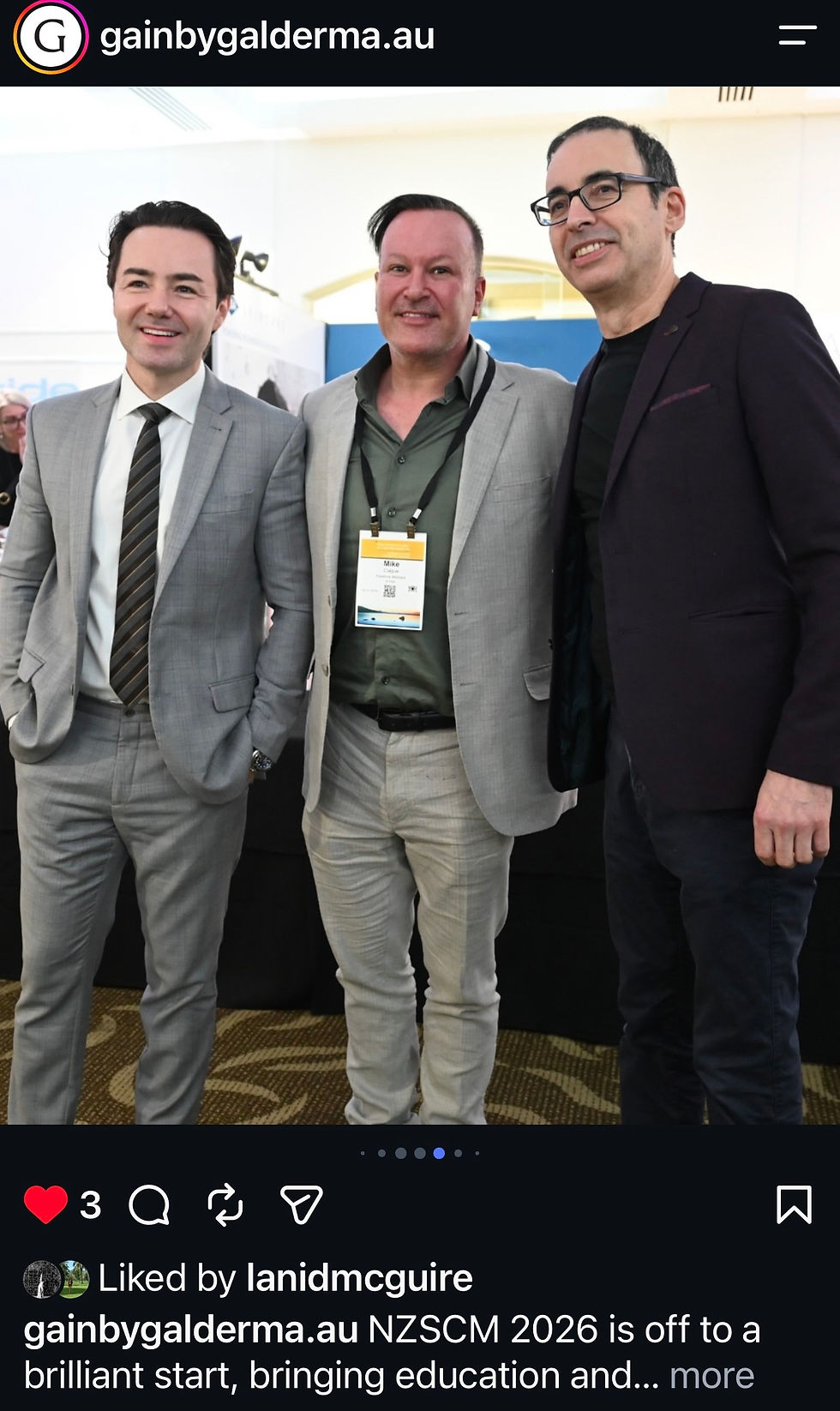
Dr Marcus Morais presented on menopausal skin health, a novel NASHA-HD for chin retrusion and medication-driven weight loss with Dr Ellen Selkon.
Dr Niki Talic spoke about PEG-crosslinked fillers.
Dr Zac Moaveni presented on restoring facial harmony.
Dr Sarah Hart discussed the Hart Lip technique.
Dr Simone Doreian presented on lip anatomy and aesthetic balance before joining me for the live Galderma sessions.
The breadth of the programme was valuable.
But breadth is not the same as progress.
Progress comes from asking better questions.
Are we treating the patient’s anatomy or following a trend?
Are we improving skin quality or simply adding volume?
Are we creating support or creating dependency?
Are we able to explain the risk as clearly as we explain the benefit?
And can we say no?
I have worked in medical aesthetics for 23 years, performed more than 40,000 treatments, contributed to 12 peer-reviewed publications and taught as an Adjunct Lecturer in Practice at Monash University.
Those years have made one thing increasingly clear:
Technical confidence without restraint is not mastery.
Mastery is the ability to assess accurately, plan conservatively and act decisively when intervention is justified.
It is also the ability to stop.
What this means for professional education
The strongest medical aesthetics courses should not only teach injection points.
They should teach clinical reasoning.
They should show how to assess the whole face, how to recognise compensation, how to discuss limitations and how to manage complications.
That is the difference between watching an injector perform and receiving genuine professional aesthetic mentorship.
It is also the focus of my Patreon education community for doctors and nurses.
We go behind the visible procedure and examine the reasoning:
Why was this area treated?
Why was another area left alone?
What anatomical risk was being managed?
What would make the correct decision “not today”?
When is Sculptra treatment appropriate?
When is conservative HA the better tool?
When does repeated treatment become too much?
These are the conversations that shape safe, ethical practice.
They are also the conversations that rarely fit into a short social media clip.

The final takeaway
NZSCM 2026 was not valuable because we had a stage.
It was valuable because the stage made the standard visible.
The anatomy either works or it does not.
The treatment plan either makes sense or it does not.
The result either respects the patient’s face or it does not.
For me, the conference reinforced a simple principle:
Do less, but understand more.
Assess outside-in.
Work top-to-bottom.
Restore architecture before chasing detail.
Use collagen biostimulators for appropriate biological restoration and conservative HA fillers for specific structural volume loss.
And remember:
LIPS GO LAST.
The best practitioners are not the ones who always have a treatment to offer.
They are the ones who know when the safest, most ethical and most beautiful answer is NO.
Conference programme:NZSCM 2026 official programme.

Comments